The Virtual Lab: AI-human Collaboration in Medical Research
The Virtual Lab facilitates interdisciplinary research through collaboration between AI agents and human researchers. Initially, the human researcher defines two primary agents—a Principal Investigator (PI) and a Scientific Critic. The PI agent automatically assembles a specialized team of scientific agents tailored to the specific research topic. Research in the Virtual Lab occurs through two types of meetings: team meetings and individual meetings. In both cases, the human researcher provides an initial agenda to guide the discussion, and then the agents discuss how to address the agenda. After running multiple team or individual meetings in parallel, the PI agent conducts a final individual aggregation meeting. With assistance from the human researcher, the PI synthesizes the previously generated tool scripts and summarizes the outcomes of earlier discussions, constructing a comprehensive workflow tailored to the initial research topic. Finally, the human researcher leverages this finalized workflow, employing the generated tools to complete the research project.
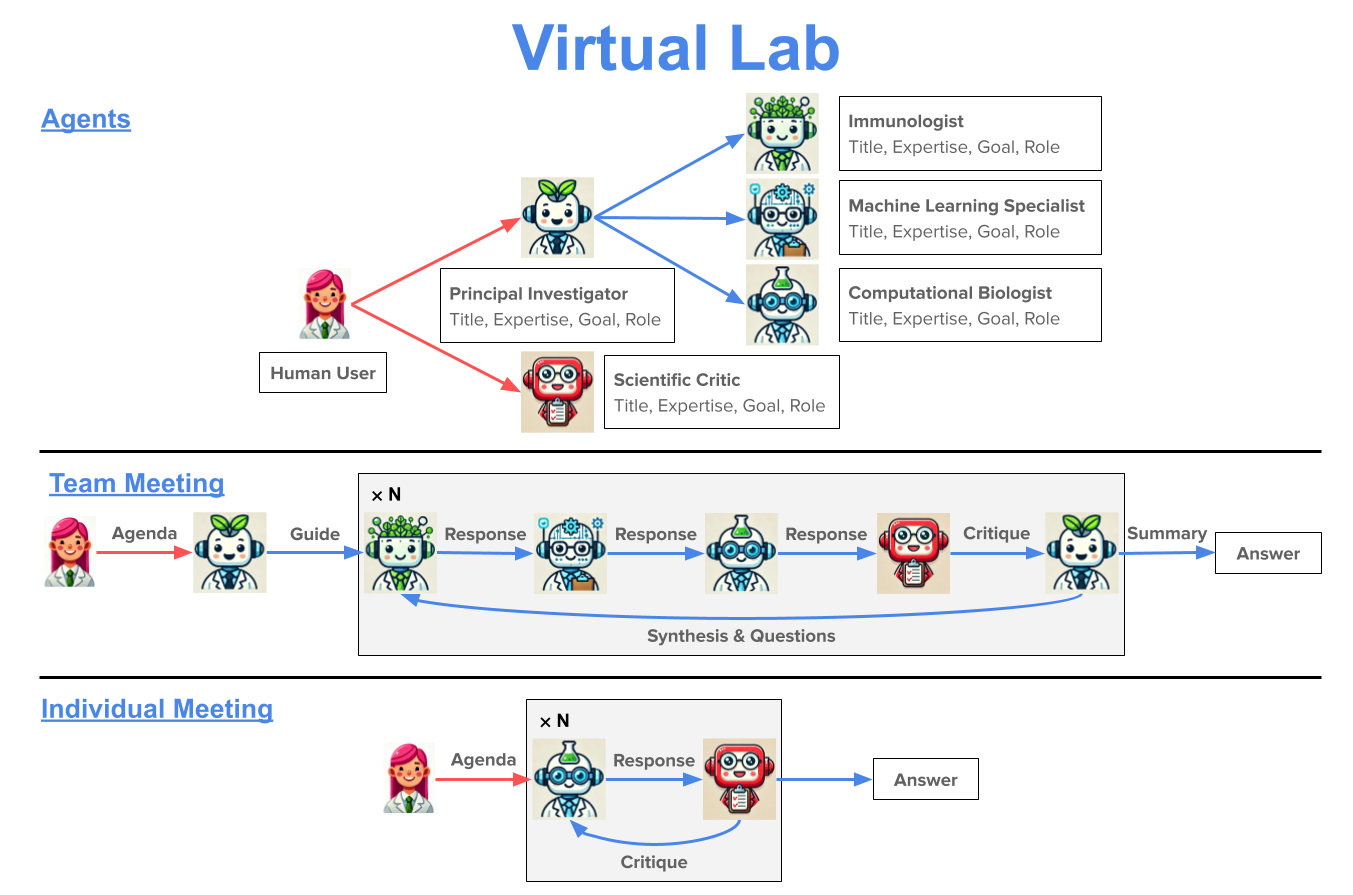
We will now use examples and prompt templates to illustrate how the Virtual Lab leverages role-play, reflection, cooperation, and tool use to guide AI–human collaboration in research.
Role-play
The Virtual Lab introduces two key roles: a Principal Investigator (PI) agent acting as the primary coordinator, and a Scientific Critic agent that provides critical oversight and identifies potential risks. Together, they ensure high-quality decision-making and maintain workflow transparency. Below we use the PI agent as an example to illustrate the key elements of an agent role:
Example of role-playing as a principal investigator
Title: Principal Investigator
Expertise: Running a science research lab.
Goal: Perform research in your area of expertise that maximizes the scientific impact of the work.
Role: Lead a team of experts to solve an important scientific problem, make key decisions about the project direction based on team member input, and manage the project timeline and resources.
Reflection
Once the human researcher defines a high-level goal, the PI agent determines which specialist scientist agents are needed (such as Sequence Designers, Structure Predictors, Energy Evaluators, and Evidence Retrievers) in an individual team generation meeting. Individual meetings allow an agent to focus on a specific task, the Scientific Critic provides targeted feedback after each response, guiding the agent toward improved outcomes. During the team generation meeting, the PI outlines each agent's title, expertise, goal, and role, the Scientific Critic then reviews these assignments and provides feedback to refine the roles before execution begins. The following example illustrates how a PI agent might generate a suitable team for a given research task and how the reflection process operates in practice.
Example of team generation (Principal Investigator)
INPUT:
Project: You are working on a research project to use machine learning to develop antibodies or nanobodies for the newest variant of the SARS-CoV-2 spike protein...
Task:Generate a team of 3 scientists to help you with this project.
OUTPUT:
Agent 1:
Title Computational Biologist·
Expertise: Protein structure prediction and modeling.
Goal: Develop and refine predictive models for protein-antibody interactions.
Role: Provide insights into molecular dynamics and structural constraints impacting antibody design.
Agent 2:...
...
Example of reflection (Scientific Critic)
Chat History:...
Task: Please critique (agent)'s most recent answer.
OUTPUT:
As the Scientific Critic, I would like to address ...
Cooperation
Team meetings involve collaborative discussions among the PI, scientist agents, and the Scientific Critic. The human researcher sets an agenda, and the PI initiates the conversation by outlining key questions. Each agent then provides their insights in turn. After several discussion rounds, the PI synthesizes the input, summarizes important decisions, and identifies next steps. The human researcher can quickly understand outcomes by reviewing only the PI's concise summary. An example of a team cooperation scenario is provided below.
Example of team generation (Principal Investigator)
INPUT:
Agenda (Provided by human researcher): You are working on a research project to use machine learning to develop antibodies or nanobodies for the newest variant of the SARS-CoV-2 spike protein. Please create ...
Agenda questions (Provided by human researcher):
1. Will you design standard
antibodies or nanobodies?
2. ...
Team members: Computational Biologist, Scientific Critic, ...
Task: Provide your initial thoughts on the agenda as well as any questions you have to guide the discussion among the team members.
OUTPUT:
Thank you, everyone, for joining this important meeting. Our task is to ...
Example of team member discussion (Computational Biologist)
INPUT:
Chat History:...
Task: P: Provide your thoughts on the discussion (round 2 of 5).
OUTPUT:
As the Computational Biologist, I will focus on ...
Example of summarizing the discussion (Principal Investigator)
INPUT:
Chat History: ...
Task:
Summarize the meeting in detail for future discussions, provide a specific
recommendation regarding the agenda, and answer the agenda questions (if any) based on the discussion
while strictly adhering to the agenda rules (if any).
OUTPUT:
Summarization of each team member: Computational Biologist: ...
...
Recommendation::Based on the input from the team, I recommend focusing on ...
Answers of agenda questions::
1. Will you design standard antibodies or nanobodies?
Answer: Nanobodies.
Justification: Nanobodies offer superior stability, tissue
penetration, and ...
2. ...
Next Steps: 1. Data Acquisition and Verification: Collaborate with partners and
use automated alerts to acquire and verify the latest cross-reactivity data for selected nanobodies.
2. Model Development: ...
Tool use
After finalizing project details in the team meeting, the agents move forward with the help of human researchers to complete the steps of tool generation and tool implementation. In the tool generation phase, the agents hold another team meeting to collaboratively choose the computational tools they will use. Here is an example showing how the team generates appropriate tools during the meeting.
Example of tool generation discussion (Computational Biologist)
INPUT:
Project:You are working on a research project to ...
Summaries of the previous meetings: Your team previous decided to modify existing nanobodies to improve their binding to the newest variant of the SARS-CoV-2 spike protein ...
Chat History of current meeting: ...
Task:Please list several tools (5-10) that would be relevant.
OUTPUT:
... Apply AlphaFold or Rosetta to model the 3D structures of the top-ranked nanobody variants ...
Once the toolset is agreed upon, the implementation phase begins. First, the PI holds an individual meeting to assign specific computational tools to each specialist agent. Next, each specialist agent conducts their own individual meetings, guided and assisted by the human researcher, to generate structured scripts for the assigned tools. Under the guidance of the human researcher, the agents iteratively refine these scripts through feedback. The human researcher then manually stores the finalized scripts for subsequent implementation. The following example illustrates how a specialist agent generates a structured Rosetta script under the guidance of a human researcher:
Example of tool implementation (Computational Biologist)
INPUT:
Project: You are working on a research project to ...
Decision:Your team previous decided to modify existing nanobodies to improve their binding to the newest variant of the SARS-CoV-2 spike protein..
Task(Provided by human researcher): Now you must use Rosetta to calculate the binding energy of nanobody-antigen complexes. You must do this in 3 parts. First, write a complete RosettaScripts XML file ...
OUTPUT:
Part 1:RosettaScripts XML for Binding Energy Calculation:
<xml>
...
</xml>
Part 2:Rosetta Command Example
'''bash rosetta_scripts.default.linuxgccrelease ...'''
Part 3:Python Script to Process Score Files
import os import pandas as pd ...
If you find this work helpful, please consider citing our paper:
@article{hu2025hands,
  title={Hands-on LLM-based Agents: A Tutorial for General Audiences},
  author={Hu, Shuyue and Ren, Siyue and Chen, Yang and Mu, Chunjiang and Liu, Jinyi and Cui, Zhiyao and Zhang, Yiqun and Li, Hao and Zhou, Dongzhan and Xu, Jia and others},
  journal={Hands-on},
  volume={21},
  pages={6},
  year={2025}
}